
When war disrupts energy markets, trade routes, and international supply chains, the consequences do not stop at borders. They move through ports, prices, farms, and eventually dinner tables.
One of the clearest examples is fertilizer.
Modern agriculture depends not only on land, rain, and labor. It also depends on industrial inputs whose prices are shaped by global energy and commodity markets. Nitrogen fertilizers are especially exposed because ammonia production remains central to the fertilizer industry, and ammonia production is still heavily tied to fossil-fuel-based systems. The International Energy Agency notes that ammonia is the starting point for all mineral nitrogen fertilizers and that around 70% of ammonia is used to make fertilizers. International Energy Agency: Ammonia Technology Roadmap
That means a conflict far from a farmer's field can still raise the cost of planting that field.
The war in Ukraine made this vulnerability visible. It disrupted fertilizer trade patterns, intensified uncertainty, and exposed how dependent many agricultural systems are on imports and distant supply chains. IFPRI's analysis of global fertilizer trade after the war-related price spikes shows how sharply these shocks can reshape flows of fertilizer around the world. IFPRI: Global fertilizer trade 2021-2023
For large, well-capitalized farms, a fertilizer shock may be painful but manageable. For smallholders and subsistence producers, it can be existential.
A rise in fertilizer prices can mean planting less. It can mean applying less. It can mean taking on debt, accepting lower yields, or abandoning a field that no longer seems worth the risk. In communities already operating close to the margin, fertilizer volatility is not just a market event. It is a food security problem, a household stability problem, and a land productivity problem.
IFPRI has emphasized that fertilizer price shocks are not felt equally, and that smallholders, especially in Africa, are among those most exposed. IFPRI: Who's afraid of high fertilizer prices?
This is where the conversation needs to become more practical.
The question is not only how farmers can access fertilizer. It is also how they can lose less of what they already have.
The hidden problem: fertilizer is not useful if the field cannot hold it
A farmer can buy fertilizer, carry it to the field, and apply it at the right moment. But if the land is exposed, sloped, compacted, or degraded, rain can carry away part of that investment.
Runoff does not only move water. It can move topsoil, organic matter, phosphorus, nitrogen, and other nutrients. On fragile land, the farmer pays for fertility, then watches part of it disappear downhill.
This loss is often invisible at first. It does not always look like a disaster. It may look like slightly thinner soil after every rainy season, weaker growth, more runoff, and a field that quietly requires more input to produce the same result.
Over time, this becomes a trap.
The field becomes less resilient. The farmer becomes more dependent on external inputs. Then, when a fertilizer shock comes, the entire system becomes more fragile.
That is why agricultural resilience cannot be reduced to input supply alone. It must also include field systems that help land retain water, soil, and nutrients in the first place.
Why vetiver deserves attention
Vetiver, known scientifically as Chrysopogon zizanioides, is a perennial grass used around the world for soil and water conservation. It is not primarily planted as a food crop. It is planted as a living tool.
Its value comes from its structure.
When established in dense hedgerows, vetiver forms a stiff barrier above ground and a deep, massive root system below ground. This combination allows it to slow runoff, trap sediment, stabilize slopes, reduce erosion, and help keep soil in place.
In practical terms, a vetiver hedge can help transform the way water moves through a field.
Instead of rainfall rushing across exposed soil, water is slowed. Sediment is trapped. Organic matter and nutrients are more likely to remain within the productive area. Over time, these small physical changes can support better moisture conditions and more stable field performance.
This does not make vetiver a miracle plant. It does not replace good agronomy, crop planning, composting, appropriate fertilizer use, or farmer knowledge. It is not a universal answer to every soil problem.
Its importance is more specific and more useful.
Vetiver helps the field hold on to what it needs.
A resilience tool, not a slogan
Research has shown that vetiver grass hedgerows can reduce nutrient losses from fertilized sloping farmland while maintaining crop yield. One field study published in Science of the Total Environment found that vetiver hedgerows significantly reduced nitrogen and phosphorus losses from fertilized sloping land. Science of the Total Environment: Vetiver hedgerows and nutrient loss
More recent research on vegetative hedgerow systems also reinforces the broader principle: well-designed hedgerows can reduce erosion and nitrogen loss on sloping land. Ecological Indicators: Vegetative hedgerows, erosion, and nitrogen loss
This matters because field resilience is not abstract. It is built through practical structures that change what happens when rain falls, when soil is exposed, and when nutrients are at risk of leaving the field.
In this sense, vetiver is not only an environmental intervention. It is also an economic one.
If a farmer can reduce erosion, retain more sediment, keep more nutrients in place, and improve moisture conditions, the field becomes less wasteful. Scarce inputs can become more efficient. The land becomes less dependent on constant rescue from outside.
For vulnerable farmers, that difference matters.
The policy lesson: access matters, but so does independence
Governments and development agencies are right to care about fertilizer access. Farmers need tools, inputs, seeds, training, infrastructure, and fair markets. But input access alone cannot be the entire strategy.
A system that depends too heavily on imported inputs remains exposed to the next shock.
The World Bank has noted that fertilizer markets remain sensitive to geopolitical tensions, trade restrictions, supply-side disruptions, and strong demand. World Bank: Fertilizer prices and geopolitical risk
That means agricultural resilience must include two complementary goals.
First, farmers need better access to the inputs and services that help them produce.
Second, farmers need field-based systems that reduce losses, protect fertility, and lower vulnerability when those inputs become expensive or unavailable.
Vetiver belongs in that second category.
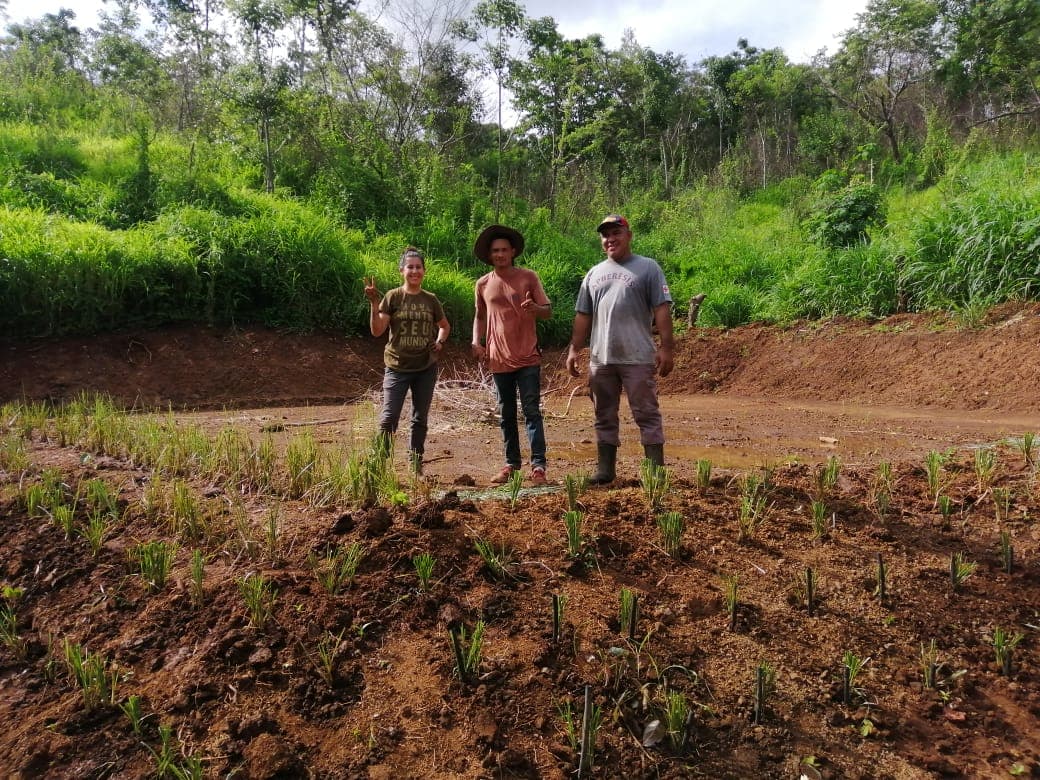
It is locally deployable. It can be propagated. It can be integrated into farms, slopes, paths, gullies, canals, and field boundaries. Once established and well managed, it can keep serving the land year after year.
That long-term function is what makes it valuable.
Why this matters for VSF
At Vetiver Sans Frontieres, we see vetiver not as a slogan, but as a practical system for communities facing erosion, land degradation, and rising input pressure.
Our work begins with a simple idea: resilience becomes more real when farmers and communities can rely not only on external supply chains, but also on living field systems that protect the physical base of agriculture.
That physical base is soil. It is water. It is fertility. It is the ability of a field to keep producing after heavy rain, drought pressure, or economic shock.
Vetiver can help protect that base.
It can slow runoff. It can reduce erosion. It can trap sediment. It can help nutrients stay closer to where crops need them. It can support land restoration in places where degradation has made farming more difficult and more expensive.
This is especially important in regions where farmers face multiple pressures at once: rising input costs, fragile soils, deforestation, erosion, limited infrastructure, and unpredictable rainfall.
No single plant can solve all of that.
But a practical field system that helps farmers lose less can become part of a much larger solution.
From crisis response to field resilience
Fertilizer shocks reveal something uncomfortable about modern agriculture: many farms are productive, but fragile. They can perform when inputs are available and affordable, yet struggle when those inputs become scarce or expensive.
The poorest farmers often pay first when that fragility is exposed.
They should not also be the last to benefit from practical solutions that help them retain more soil, conserve more water, and protect more fertility.
That is the opportunity before NGOs, donors, government officials, and rural development partners.
The goal is not only to respond after the next crisis arrives. The goal is to help communities become less vulnerable before it does.
Vetiver is one tool for that work.
It is not a replacement for policy, infrastructure, agronomy, or farmer-led knowledge. But it is a powerful reminder that resilience can be built directly in the field, one contour line, one slope, one nursery, and one living barrier at a time.
Support field resilience
Vetiver Without Borders helps communities document, test, and deploy practical vetiver systems for erosion control, soil restoration, and agricultural resilience. Support our work to help farmers protect soil, water, and fertility before the next shock arrives.